The Garmin Fenix 8 and Enduro 3 are two of Garmin’s most impressive GPS watches yet—but which one should you strap to your wrist? Do you go for maximum durability, unbeatable battery life, and rugged practicality, or opt for premium features, sleek design, and versatile smart capabilities? Stick around, because today we’re breaking down exactly why I chose the Garmin Enduro 3 over the Fenix 8, and which watch might be the perfect fit for your adventures.
Key Differences Between Enduro 3 and Fenix 8 Solar
Quick-specs (51 mm models)
- Enduro 3 weight: 63 g with UltraFit nylon band
- Fenix 8 Solar weight: 95 g with silicone/TPU band
- Enduro 3 display: 1.4-inch MIP + Power Sapphire, wide solar ring
- Fenix 8 Solar display: 1.4-inch MIP + new solar design
- Enduro 3 battery: 36 days typical / 90 days with solar
- Fenix 8 Solar battery: 30 days typical / 48 days with solar
- GPS-only battery: Enduro 3 about 120 h typical; Fenix 8 Solar about 95 h typical / 149 h with solar
- Mic / speaker / voice assistant: Enduro 3 has no speaker/microphone or offline assistant; Fenix 8 adds calls and offline assistant
- Diving: Enduro 3 is 10 ATM water-rated only; Fenix 8 adds scuba / apnea to 40 m with leak-proof inductive buttons
- ECG: both use Elevate 5 sensor; ECG app rolling out regionally
- Rucking features: yes on both via software update
- Street price (May 2025): Enduro 3 about US $800–900; Fenix 8 Solar about US $1,000 after recent $200 drop
I started using Garmin GPS watches because I needed better battery life, especially for long hikes and multi-day trips. I went from the battery-anxiety-inducing Vivoactive 4 to the polar opposite—the Instinct 2 Solar—before upgrading to the Fenix 7 Solar.
The Fenix 7’s battery is good, but I wanted something that could last a whole trip without worrying about charging, mainly for summer activities. A bonus is the built-in LED flashlight. It’s really handy in Norway, because of the long dark days during the winter. This all brought me to the Fenix 8 and the Enduro 3.
Firstly, it’s important to understand that the Enduro 3 is essentially almost identical to the 51 mm Fenix 8 Solar with a Memory-in-Pixel display, with a few but important differences.
Target Audience
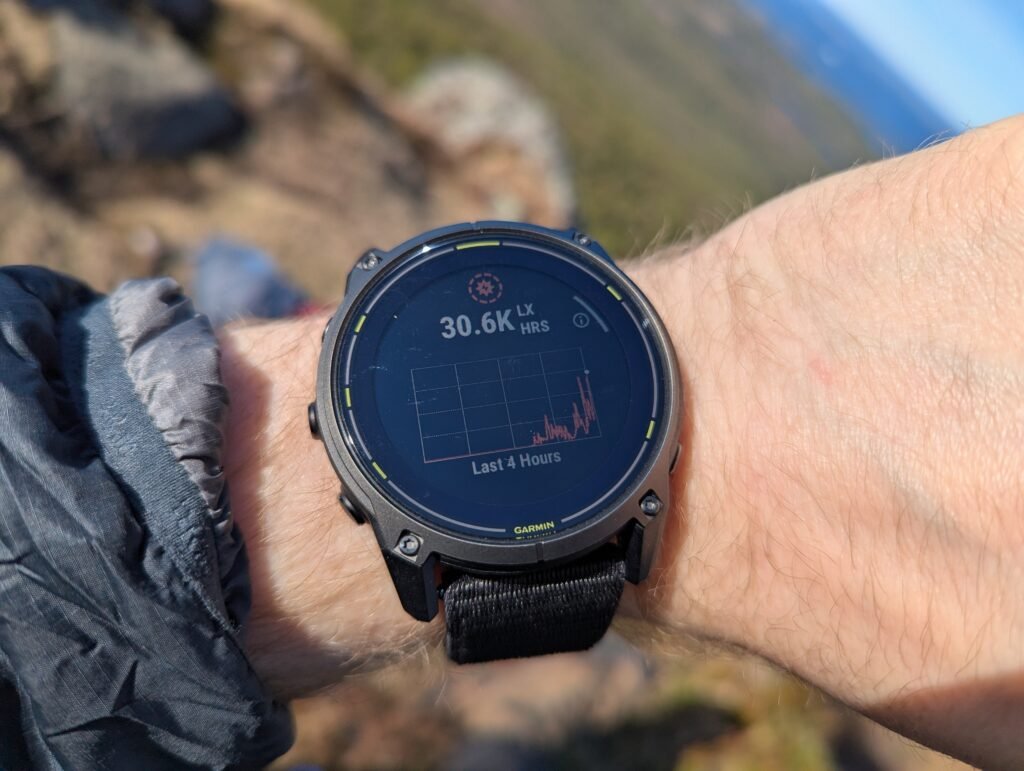
When comparing the Enduro 3 and Fenix 8 Solar, a few key differences emerge clearly. The Enduro 3 is specifically tailored towards unbeatable battery life and affordability—at least compared to the Fenix 8 series. It features a larger solar panel, a lighter construction, and comes at a lower price point.
The Fenix 8 Solar offers premium titanium construction, greater weight, and extras like a speaker, microphone for calls and voice assistants, and diving capabilities up to 40 meters with leak-proof buttons.
Battery life & solar differences
Garmin beefed up both watches, but Enduro 3 still wins by a mile. For long hikes and bike rides, it’s just easier to have a device with great battery life. You don’t want to worry about it, especially if you’re using maps, the flashlight, navigation while hiking, built-in music, and different satellite modes.
My previous Fenix 7 Sapphire Solar managed around 6 days of continuous GPS tracking with about 8 hours of tracking each day until the battery got to less than five percent. I anticipate achieving up to 60 days of battery life this summer in Norway, where daylight lasts nearly around the clock.
Build, weight & cold-weather comfort
At 63 g the Enduro 3 feels closer to a Forerunner than a Fenix on the wrist. Garmin ditched the metal back for fiber-reinforced polymer to save grams and keep the watch from feeling ice-cold against your skin on Nordic ski days. The Fenix 8 keeps the classic full-metal sandwich; it’s bomb-proof but you’ll notice the extra 30+ g.
I genuinely appreciate the Enduro 3’s design choices tailored for outdoor enthusiasts—like the lightweight resin back that remains comfortable against the skin even in freezing temperatures. The Fenix 7’s titanium back felt noticeably cold in chilly weather below 0°C while hiking or cross-country skiing.
Smart extras: why Fenix 8 costs more
- Speaker + Mic – accept calls or fire off a voice note mid-run; you also get offline voice assistant for phone-free commands.
- Leak-proof inductive buttons & scuba mode – sealed buttons let you dive to 40 m.
If you need those, then the Fenix might be for you. I still prefer the Enduro 3 because all the space used for speaker and microphone is utilized for a larger battery instead.
Enduro 3 advantages that sealed the deal for me
- Lighter and warmer – the polymer back is a blessing on winter hikes.
- Monster battery and larger solar panel.
- Lower price – I’d rather spend the US $150–200 saved on gear or plane tickets.
- Simplicity – I don’t take wrist calls, dive, or use voice notes.
- The nylon band – super comfortable day to day compared with TPU.
The AMOLED wild-card
Yes, the Fenix 8 AMOLED edition is in my opinion flat-out the best-looking Garmin yet—razor-sharp. Especially the one with the silver colored bezel looks particularly good. But you drop to roughly one-third the GPS battery. If you live in the city and want a 24/7 showpiece, that’s your pick. For back-country days and long-haul hiking trips without access to charging I’ll stick with MIP.
What should you choose?
There’s no “better” watch—only the better match. If you’re the kind of athlete who packs a power bank anyway and loves smart conveniences like calls, voice assistant, diving, and ECG, the Fenix 8 Solar is worth the weight and price. If aesthetics is key and you want the best watch that also looks good, go for the Fenix 8 AMOLED. If you want a watch that feels like it disappears on your wrist and sips power for weeks on end, the Enduro 3 is the unrivalled endurance champ.
You will have to live with the more pronounced lime green accents, but that is in my opinion a small price to pay for all the advantages it brings along.