April 9-16, 2026 — your weekly roundup of Garmin news, software updates, and the wider wearable health tech world.
This week was less about leaks and more about receipts. Garmin shipped a real product (the D2 Mach 2 Pro), WHOOP turned its long-rumored muscle-oxygen ambitions into a granted US patent, and we now know that Garmin’s twin-trademark leaks last week describe two different products, not one. Plus a stable firmware drop for the Fenix 8 line, a quirky Venu X1 fix, and a free third-party tool that turns your Garmin recovery data into a strength workout.
Let’s get into it.
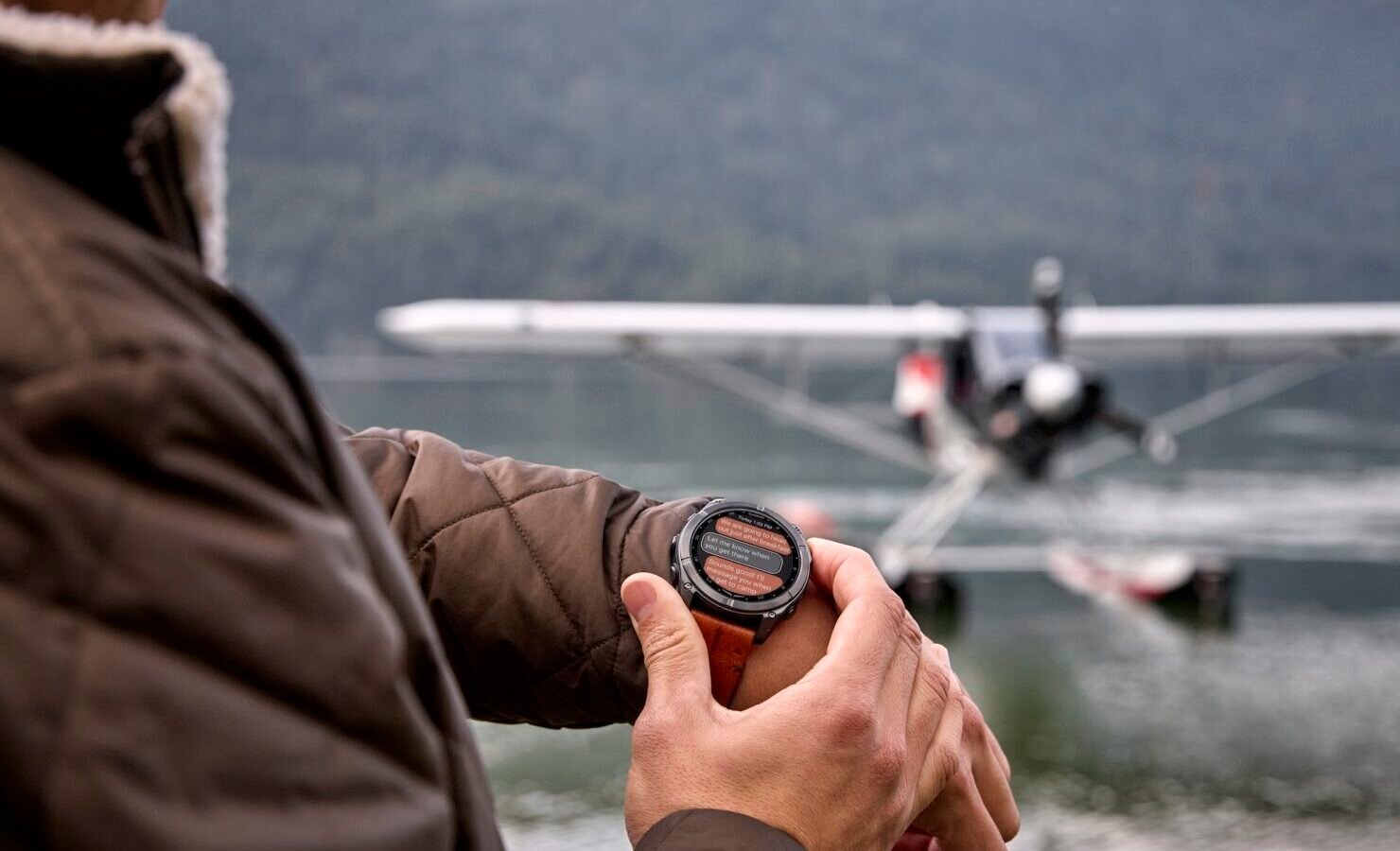
1. Garmin D2 Mach 2 Pro: inReach + LTE-M wrapped in titanium
Garmin officially launched the D2 Mach 2 Pro on April 14 at $1,549.99 — a striking $50 premium over the standard D2 Mach 2 51mm for what is effectively a connectivity overhaul.
What you actually get for the upgrade:
- inReach two-way satellite messaging with interactive SOS routed to the Garmin Response Center
- LTE-M cellular for messaging without your phone tethered
- Voice calling between Garmin Messenger users (note: not to standard mobile numbers)
- LiveTrack and weather over both satellite and cellular
The trade-offs are real: the case grows from 14.7mm to 16.5mm, smartwatch battery dips from 26 to 24 days, and GPS modes lose 6-8 hours. It’s only available in 51mm Carbon Grey DLC titanium. inReach connectivity also carries an ongoing subscription starting at $7.99/month.
It’s pitched at pilots, but for the rest of us it’s a clear preview of where LTE + satellite will trickle down across the Fenix, Tactix, and Enduro lines later this year.
Hands-on coverage by The5KRunner and Notebookcheck.
2. WHOOP gets its muscle-oxygen patent — and it’s pressure-aware
A week after Garmin’s “Muscle Battery” trademark leak, WHOOP fired back with paperwork of its own: US Patent 12,594,037 B2, granted April 7, 2026, was first surfaced by The5KRunner on April 13.
The patent covers a near-infrared spectroscopy (NIRS) sensor — two narrow-band LEDs at ~660nm and ~855nm with three to four photodetectors at 5-50mm spacing — designed for the thigh, arm, chest, or waist. Explicitly not the wrist.
The clever bit is the strap itself: embedded pressure and tension sensors detect when you’ve cinched the strap differently between sessions (a perennial problem with SmO2 measurement) and even unlock supervised blood-flow restriction training as a feature.
Filed in 2019 and granted now, with no commercial release announced. Earliest realistic launch is 2027 — but the strategic contrast with Garmin is sharp:
- Garmin “Muscle Battery” → an algorithm/software layer on top of SmO2 data
- WHOOP NIRS strap → purpose-built hardware, willing to live off the wrist
Two very different bets on the same physiological metric. The market for everyday-athlete muscle oxygen is officially open.
3. Garmin CIRQA and Muscle Battery: confirmed as separate products
Speaking of those Garmin trademarks — The5KRunner clarified on April 12 that CIRQA and Muscle Battery are two different products, not one.
- CIRQA: a wrist or arm recovery band positioned against WHOOP and the Polar Loop, built around HRV
- Muscle Battery: a separate NIRS sensor system that has to sit directly on the target muscle — shielded from light, repositioned per session — and which is physically incompatible with a wristband
The expectation is that both feed into the same Garmin Connect ecosystem rather than merging. Strength training, recovery, and food logging tie everything together at the software layer — classic Garmin platform play.
4. Fenix 8 stable v21.39 is here
Garmin promoted the v22.21 beta fixes into the stable channel on April 14. Stable System Software 21.39 is rolling out for:
- Fenix 8 AMOLED
- Fenix 8 Solar
- Enduro 3
- Fenix E
- Tactix 8
If you skipped the beta, this is the one to install. Bug fixes and stability improvements, no major new features — exactly what you want from a stable patch. Details at Garmin Rumors.
5. Venu X1 v16.40: small fix, fast turnaround
Just two weeks after v16.37, the Garmin Venu X1 received another stable update. The headline fix is small but matters: the device serial number now displays correctly on the “About” page, which actually matters for warranty claims and customer support.
Notably, this update is exclusive to the Venu X1 — no parallel rollout for the Venu 4 or vivoactive 6. Auto-installs via Garmin Connect Mobile or Garmin Express. GSMGoTech and Notebookcheck have the details, with confirmation on the Garmin Forums.
6. FORMA: free third-party tool turns Garmin recovery data into a strength workout
A nice example of the developer ecosystem forming around Garmin’s recovery metrics. FORMA is a free web tool from a solo developer (training on a Forerunner 255) that takes four inputs:
- HRV status
- Body Battery
- Sleep score
- Training-load ratio
…and prescribes a strength workout for that morning — exercises, sets, reps, rest. Deterministic (no AI, no randomness — same inputs always give the same output), no account needed. Currently free during early access at app.forma.coach.
It’s not a periodization program — it tunes today’s session to today’s recovery state. Worth a look if you’re already using Garmin’s HRV and Body Battery to drive readiness decisions. Reviewed by The5KRunner on April 13.
7. The Apple Watch sidebar
Two notes from Cupertino this week:
- watchOS 26.5 Developer Beta 2 dropped on April 13 alongside iPadOS, tvOS, and visionOS 26.5 — Apple continues its push to release platform updates in lockstep. Mostly bug fixes for now, per MacRumors.
- watchOS 8.8.2 — the security patch for older Apple Watches — is reportedly causing app installation failures, crashes, and battery drain on Series 6 and SE units. Even Apple’s own apps like Maps and Weather are failing to install for some users. Coverage at MacTech.
A reminder that the long tail of OS support sometimes hurts the very users it’s meant to protect.
8. Polar Street X: full review verdict
The full review for the Polar Street X landed on April 14 following last week’s 200-mile battery test.
The verdict in one line: “a lifestyle-first watch with genuine training credentials” at GBP 186, with the complete Polar recovery suite and no subscription.
What works: MIL-STD-810H build, a comfortable 48g, 170+ sport profiles (skateboarding and inline skating included).
What doesn’t: single-frequency GPS struggles in dense urban environments, an older-generation HR sensor that reads ~10 bpm off during cycling and intervals, sleep staging gets shaky after hard sessions, and there are no offline maps or contactless payment.
Bottom line: pair it with a chest strap if zone training matters, or look at the Garmin Instinct 3 if GPS precision is non-negotiable.
9. Coming up: Garmin Q1 earnings, April 29
Mark the calendar — Garmin Ltd. reports Q1 2026 earnings Wednesday, April 29 at 10:30am EDT. Things worth listening for:
- CIRQA timing and any official acknowledgment
- Connect+ subscriber growth
- Outdoor segment guidance (the “biggest year ever” narrative from the Q4 call)
- Any color on the LTE / satellite trickle-down strategy that the D2 Mach 2 Pro just previewed
Official details at Garmin Newsroom.
That’s the week. The pattern keeps repeating: Garmin builds a software platform that absorbs every input (recovery, food, strength, SmO2, satellite, LTE), while WHOOP, Polar, COROS, and Suunto each pick a sharper edge to compete on. The next big tell is that April 29 earnings call.
See you next week.