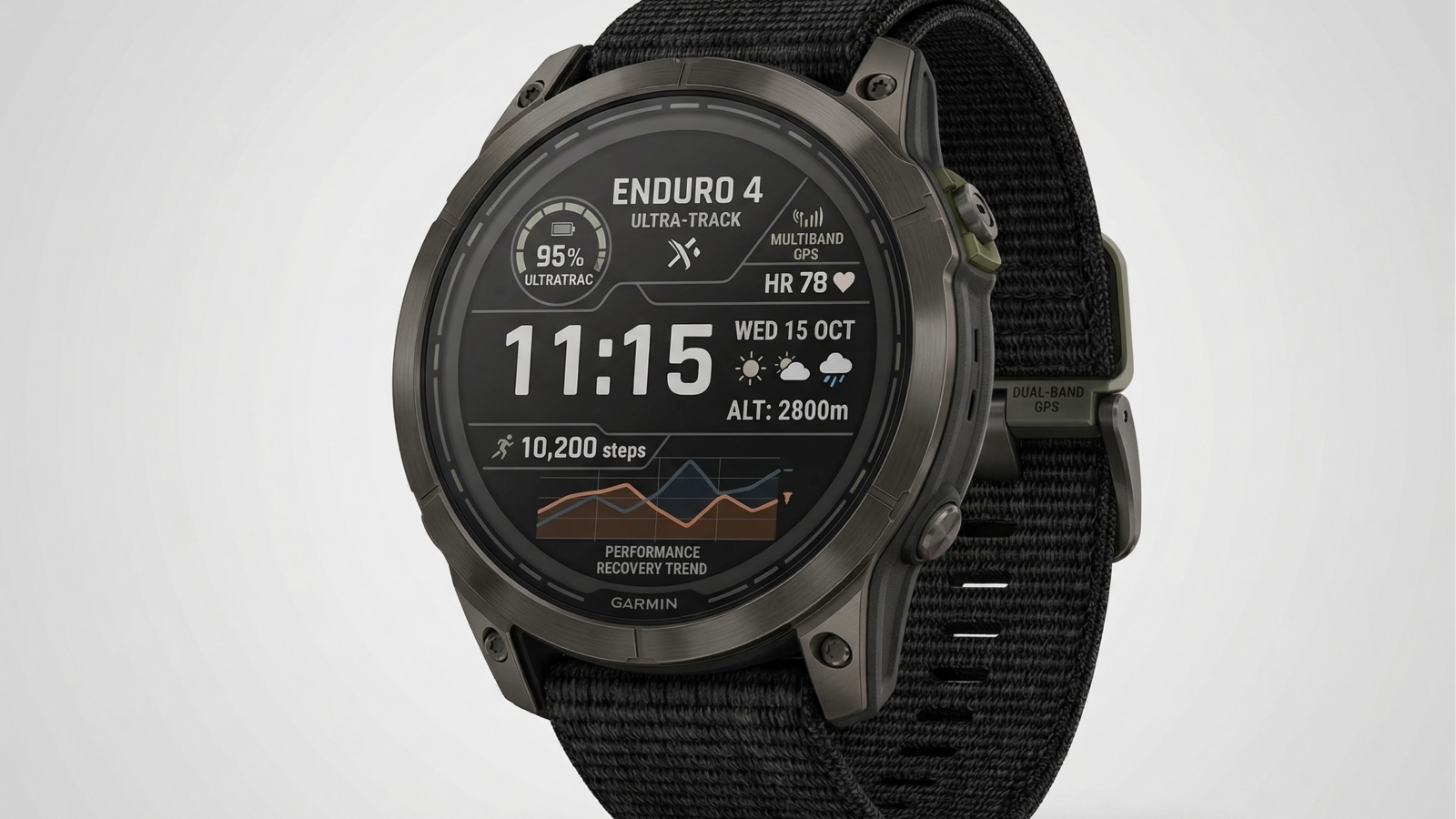
The Garmin Enduro line started as a niche ultrarunning watch. Three generations later, it has become Garmin’s most capable outdoor tool. The Enduro 3 launched in mid-2024 with solar charging, a transflective MIP display, and battery life that stretches past 320 hours in GPS mode with solar. Each generation has roughly doubled the GPS battery life of the one before it: 80 hours, then 150, then 320. By late 2026, the Enduro 3 will be the oldest major product line in Garmin’s outdoor segment. Here is why the Enduro 4 could be next and what it might bring.
How the Enduro line evolved from niche to flagship
The original Enduro launched in 2021 as a stripped-down Fenix 6X with a solar panel and oversized 51mm case. It targeted ultra runners who needed a watch that lasted an entire 100-mile race without a charger. Battery life was the headline feature, but the watch lacked a lot of features compared to the fenix 6X.
The Enduro 2 arrived in 2022 and added multi-band GPS, a built-in LED flashlight, and an upgraded solar panel that captured more energy in less time. It borrowed the best features from the Fenix 7X Solar and wrapped them in a lighter titanium case. This was the generation that moved the Enduro from “ultra runner tool” to “serious expedition watch.” This was basicly a modified version of the fenix 7x with better batterylife.
The Enduro 3 in 2024 was the biggest leap yet. Garmin cut the weight to just 63 grams with the ultrafit nylon strap, added the Elevate v5 heart rate sensor, introduced next-generation solar efficiency, and delivered up to 320 hours of GPS battery life with solar. It also brought full TopoActive mapping, training readiness, and HRV status from the Fenix 8 platform. For the first time, the Enduro matched the Fenix feature-for-feature on software while crushing it on battery life. This was enough for me to upgrade to from my 47mm Fenix 7 Sapphire solar to Enduro 3, and boy has it been an upgrade.
Each generation has followed a clear arc: longer battery, lighter build, more features borrowed from the Fenix. The Enduro 4 should continue that trajectory.
Why 2026 points to an Enduro 4 launch
Garmin has released a new Enduro roughly every 18 to 24 months. The Enduro 1 arrived in February 2021, the Enduro 2 in August 2022, and the Enduro 3 in mid-2024. If the pattern holds, an Enduro 4 could show up anywhere between late 2025 and mid-2026. Given that Garmin CEO Cliff Pemble hinted at major outdoor launches in H2 2026, a simultaneous Fenix 9 and Enduro 4 reveal is very much on the table – especially given how they did exactly did that with the launch of Fenix 8 and Enduro 3.
There is also a strategic argument. The Fenix 8 still offers Solar/MIP, but only in 47mm and 51mm sizes. AMOLED is clearly the priority. The Enduro has become the purer expression of what solar and MIP can do: maximum battery, minimum weight, no compromises for display vibrancy. Hikers, mountaineers, and ultra runners who pick battery life and sunlight readability over screen animations need a flagship built around those priorities. With the high likelyness of the Fenix 9 beeing exclusively AMOLED, the Enduro 4 is the natural answer for meny of the above mentioned users.
Competition adds pressure too. COROS has built a strong reputation in the ultra-endurance space with the Vertix line and the APEX 2 Pro. Suunto’s Vertical offers solar charging with full offline maps. If Garmin waits too long to refresh the Enduro, these brands will chip away at a segment Garmin currently owns.
Features we expect to see on the Enduro 4
Better solar efficiency. Each Enduro generation has squeezed more power from its solar panel. The Enduro 3 uses a larger active solar panel area than previous models. The Enduro 4 could adopt next-generation photovoltaic cells with higher conversion efficiency, pushing GPS battery life past 400 hours with solar. In smartwatch mode, we might see claims approaching “unlimited” battery for users in sunny climates, similar to what we see on the Insinct 3 line.
Lighter weight. At 63 grams (with nylon strap), the Enduro 3 is already one of the lightest full-featured GPS watches on the market. The Enduro 4 could push below 60 grams through a thinner titanium case or carbon-reinforced polymer back. Every gram matters on a 100-mile run, and breaking the 60-gram barrier would be a marketing headline.
Improved MIP display. The transflective MIP screen is the Enduro’s signature advantage. It more or less reads perfectly in direct sunlight without any backlight. The Enduro 4 could possibly get a higher-resolution MIP panel with better contrast and possibly limited color improvements. Garmin has been quietly improving MIP technology, and the Enduro is the perfect platform to showcase those advances.
Satellite communication. This is probably the most obvious upgrade, given how the fenix 8 pro first launched with this. Garmin owns inReach, the gold standard in satellite messaging for backcountry users. The Apple Watch Ultra already offers satellite SOS. If Garmin integrates inReach messaging directly into the Enduro 4, it would eliminate the need to carry a separate satellite communicator. Two-way texting, SOS alerts, and location sharing from your wrist. That alone could justify a higher price tier, likely with a monthly subscription. No leak confirms this, but the strategic logic is strong. Now Inreach capabilyu does not mean iridium satelites, but rather the more picky Skylo connection. This is a nice safety feature, but I´ll keep my inreach mini 2 for two satelite connection for now.
4G- connection. I am pretty sure this is self explanatory. This came alongside with the InReach capabilties of the Fenix 8 pro, and the Enduro 4 wil likely use the same chipset. This is something I would find quite usefull for runs in enviroments with cellular coverage and not having to bring my phone. And this would be a genuanly usefull extension of the incident detection shuld something actually happen.
Health sensor upgrades. The Elevate v5 sensor in the Enduro 3 already tracks heart rate, SpO2, respiration, and skin temperature. The Enduro 4 could move to an Elevate v6 with better optical accuracy, add ECG capability, or improve altitude acclimatization features for high-altitude mountaineers. Body temperature spot checks would be valuable for ultra runners monitoring heat stress during long desert races, or for safety or tracking in colder environemnts.
Next-gen GPS. A faster chipset would improve map rendering and route calculation on the MIP display, where performance has traditionally lagged behind AMOLED Fenix models. SatIQ 3.0 should switch between single-band and multi-band GPS more aggressively, saving battery without sacrificing track accuracy. Improved dead reckoning for tunnels and dense canopy would help trail runners and mountaineers.
The Enduro as Garmin’s solar flagship?
The Fenix 8 still has Solar/MIP in 47mm and 51mm, but the Enduro is where Garmin pushes solar technology hardest. The Enduro 3 gets roughly three times the GPS battery life of a Fenix 8 Solar. That gap makes the Enduro the watch for users whose adventures outlast any charging opportunity. It has inherited a role beyond ultra running.
I think we with the Enduro 4 are likely to see a few outcomes based upon how Garmin is pivoting their Amoled strategy.
Thru-hikers who spend weeks on the PCT or CDT need a watch that goes days between charges. Expedition climbers above 5,000 meters need a screen they can read through glacier goggles. Military and tactical users need a rugged tool that works in the desert without a power source. Sailors on multi-day ocean races need GPS and weather data around the clock. All of these users once had the Fenix Solar. Now they have the Enduro.
1. Garmin Fenix 9 will continue in the footsteps of the Fenix 8 pro and come without memory – in pixel dispalys. Garmoin Enduro 4 becomes one of the lst MIP-based Garmins – at least for this generation. In this scenaruo Garmin released three different sizes of the Enduro 4- 42mm, 47mm, and 51mm.
2. The Enduro 4 fetures both Amoled and MIP versions. This one is har to tell, given how this is exactly what they did with the instinct line. That beeing said the instinct line is incredibly popular with a quite competitive price to performance ratio. I know many who have returned their Enduro 3 simply beacuse it was too big and would love a smaller size. And given how the Enduro 3 was basicly Garmin listening to the user feedback on the Garmin Enduro 2, i think the different sizes are more likely than amoled versions. And if the Enduro 4 will be cheaper than the fenix 9, they most likely will stick to something more niche in order not to compete(or worse cannibalize) with the Fenix 9.
Competition, pricing, and the bottom line
The ultra-endurance watch market has grown fast. Here is how a potential Enduro 4 would compare to its closest rivals.
| Feature | Enduro 4 (expected) | COROS Vertix 3 | Suunto Vertical |
|---|---|---|---|
| Display | MIP | AMOLED (1.4″) | MIP or AMOLED |
| Solar | Yes (Power Glass) | No | Yes (Solar model) |
| Battery (GPS) | ~140h (400h+ solar) | ~85 hours | ~60h (85h solar) |
| Weight | ~60-63 g | ~86 g | ~74 g (titanium) |
| Multi-band GPS | Yes (SatIQ) | Yes (dual freq) | Yes (dual band) |
| Offline maps | Yes (TopoActive) | Yes (landscape) | Yes (outdoor) |
| Water rating | 10 ATM | 10 ATM | 10 ATM |
| Price (est.) | $899-$1,099 | $599-$899 | $549-$649 |
The Enduro’s advantages are clear: best-in-class battery life with solar, the lightest weight in the segment, and Garmin’s unmatched training ecosystem. COROS counters with lower pricing and strong GPS accuracy. Suunto brings solid solar options at a more accessible price point but cannot match Garmin’s software depth or community size.
Pricing for the Enduro 4 will hopefully stay in the $899 to $1,099 range. The Enduro 3 launched at $899.99 for the base titanium model. Garmin may hold that entry price and add a premium variant with a sapphire lens or enhanced solar panel at a higher tier. That beeing said, a 100-150 dollar increase could be likely due to global chip shortage.
So the Garmin Enduro 4 is by all means not confirmed, but the signs point to a 2026 launch. By late this year, the Enduro 3 will be the oldest major product in Garmin’s outdoor lineup. Whether you are running a 200-mile race, hiking the Appalachian Trail, or deploying to a remote base camp, the Enduro 4 could be the watch that goes as far as you do. Check out the Garmin Fenix 9 rumour and speculation roundup for the AMOLED side of the story.